About
I am an electrical and computer engineering graduate. Like many people, I have a hard time understanding and retaining what I read in research papers and textbooks, so I built an agent that turns one source into an interactive guide, and you explore each mechanism yourself: step through it, choose a case, or move a slider.
Tell me which papers or topics you want broken down next.
How a lesson works
- One question, one credited source. A paper lesson follows the paper from start to finish; a textbook or course lesson answers one question, such as how a loop becomes machine instructions.
- Prerequisites fold open only if you need them. Short refreshers sit at the top of every lesson.
- Explore each mechanism. Step through a worked example, choose a case, or move a slider to see what changes.
Lessons
The reading room
Showing lessons tagged .
No lesson matches this filter.
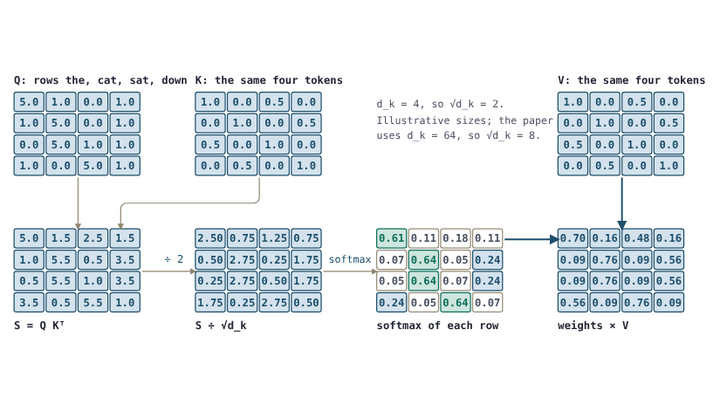
Decoded: Attention Is All You Need, the paper that introduced the Transformer
Paper: Attention Is All You Need Ashish Vaswani, Noam Shazeer, Niki Parmar, Jakob Uszkoreit, Llion Jones, Aidan N. Gomez, Łukasz Kaiser and Illia Polosukhin. Advances in Neural Information Processing Systems 30 (NIPS 2017), 2017.
Follow how the Transformer uses attention to mix information across tokens, runs several attention heads in parallel, and uses a mask to keep future tokens hidden.
Read the lesson →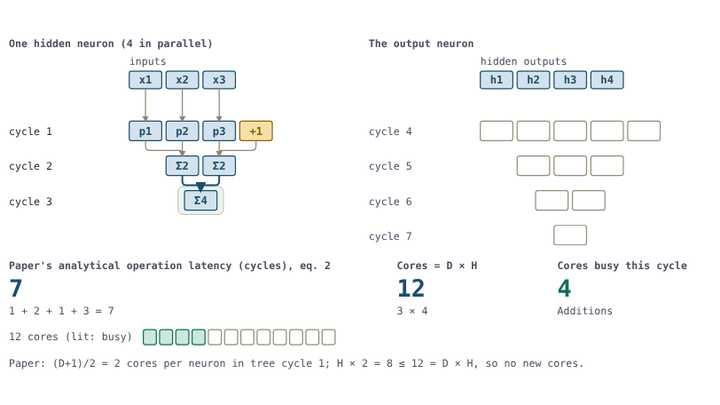
Decoded: NN-PARS, simulating a circuit with neural networks instead of lookup tables
Paper: NN-PARS: A Parallelized Neural Network Based Circuit Simulation Framework Mohammad Saeed Abrishami, Hao Ge, Justin F. Calderon, Massoud Pedram and Shahin Nazarian. 21st International Symposium on Quality Electronic Design (ISQED 2020), pp. 452–456, 2020.
Follow how NN-PARS replaces circuit-model table queries with small neural networks, schedules gates in parallel, and compares waveform error with calculated simulation speed-ups.
Read the lesson →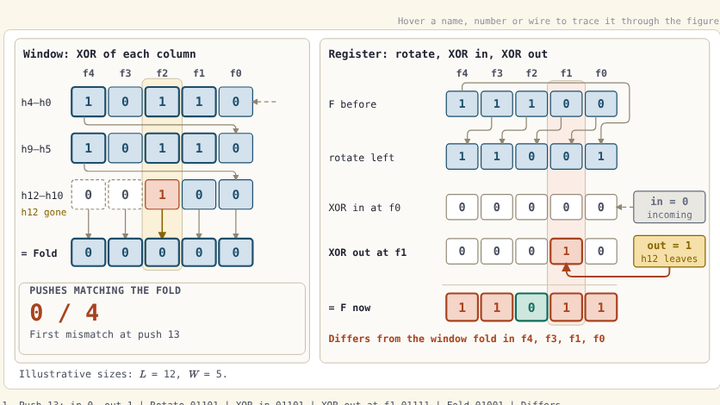
Decoded: TAGE, the branch predictor that keeps several histories at once
Paper: A case for (partially) TAgged GEometric history length branch prediction André Seznec and Pierre Michaud. Journal of Instruction-Level Parallelism, vol. 8, 2006.
Follow how TAGE chooses among several branch-history lengths, uses tags to recognize a branch, and learns which prediction entries deserve to stay.
Read the lesson →
Get in touch
Recommend a paper or topic, ask a question, or request a correction or removal. E-mail hello@decodedbyjustin.com with the lesson URL, the passage or figure concerned, and the reason for your request. For a rights concern, explain your connection to the work. Please send only information needed to review the request.
There is no contact form or tracking. The contact button opens your e-mail app. See Sources and rights for the policy and privacy details.
Contact Justin